2003 Ford Explorer Door Ajar Light Stays On

This 2003 Ford Explorer came in with several complaints; the door ajar light stays on with the doors closed and the engine running, the dome and puddle lights stay on for ten minutes after exiting the vehicle, when locking the doors the doors will lock then unlock on their own and the alarm will go off for no reason. This was pretty easy to isolate to the driver’s door ajar switch with the aid of a good scan tool. Once I found that the driver’s door ajar switch was reporting an open door no matter what position the door was in, all I had to do was confirm that it was a switch and not wiring or a computer problem.

In removing the door panel the first step is to remove the interior door handle trim panel. At the forward edge insert a small flat prying tool and release the retainers.

After removing the panel now you can lift and remove the switch trim panel assembly. There is one screw under the panel that has to be removed.

There are two screws that have to be removed from the lower edge of the door panel.

After removing all three screws lift the door panel up and towards you. Then you will need to support the panel and remove the wiring from the power mirror switch. This can be a little difficult so take your time. You will need to slide a small screwdriver blade under the retaining clip in order to release the harness connector.

Peel the left hand side of the vapor barrier back and locate the harness connector that I did not get a picture of.

Update October 21, 2011.  Well, I finally got another one of these Explorers in and took some extra pictures to show the harness connector and the wires. Note the change in paint colors

Disconnect the harness connector and with an ohm meter check the resistance of the door ajar switch,two small wires yellow/black and black. The resistance should change from an open to a closed circuit with the movement of the latch assembly. If it does not change the switch is faulty.

You may also take a jumper wire and connect the small yellow/black to the small black wire and see if the lights and locks respond properly now. A closed circuit indicates a closed door and the lights and locks should now function properly. Roll a window down before doing this so that you will not lock the keys in the car.

The backside of the harness connector. I looked at the color codes to locate the two needed wires.

In order to remove the latch assembly and or the door ajar switch the lower window track will have to be removed. There are two screws at the rear of the door.

There are three screws that hold the latch in place. There is also linkage that will have to be removed. Pay careful attention to positioning and adjustments so that reassembly will not be a problem.

After gaining access remove the harness connector and twist the switch to release and then pull. To install the new switch push the switch into position and rotate until click is felt. Reassemble door and test system as you go.

1999 Lexus ES 300 No Run Condition

1999 Lexus ES 300 was towed to the shop after an owner had removed the upper intake assembly in order to install new knock sensors. The engine now does not run at all. It took a good bit of checking and searching but in the end the problem was very simple. Here are the symptoms: the engine cranks but will not run, there is spark present but there is no fuel injector pulse, the engine will run if external fuel supply is added, the engine control computer communicates and data is present, the customer stated that the check engine light was on at one time even with the key off.
The fix was locating and reinstalling a very important missing ground located at the passenger side of the engine near the firewall. The ground had dropped down and went out of site under the a/c lines. The following are several pictures of the ground location.

A very important lesson, with today’s technologies take pictures of your work before you start taking it apart so that you can document where everything goes when you are reassembling.

2003 Chrysler Town and Country Van Blower Speed Constant

2003 Chrysler Town and Country Van came in with the complaint of the blower operates on high speed with key on and cannot be adjusted down. This procedure will also apply to Dodge Caravans with auto a/c. The controls and indicators seemed to work normally. I checked the wiring diagram and component locator and found that the blower power module is located behind the glove box. Good place to start.

After opening the glove box there are two stops the have to be depressed inward in order to drop the box down.

The blower power module is directly behind the lowered glove box. It is held in place by two 8mm hex head screws.

After removing the two attaching screws, the blower power module can be positioned for testing.

Turn the key on and while manually rotating the blower switch from low to high you should see a voltage change between about 2 volts (high)up to about 10 volts (low) on the blue/light blue wire. It is the middle wire in the left connector pictured below. Because the blower was working on high speed there was no need to do any other testing, however if you were to have low blower or no blower you would need to test further. Check for 12 volts – on the black/orange wire and 12 volts+ on the dark blue wire in the three wire connector. If either is missing check respective fuse and ground connections. Next check for 12 volts between the blue wire and the dark blue /yellow (sometimes black as pictured below) wire in the two wire connector to the right of the pictures. If either signal is missing in the two wire connector and the three wire connector tested good then the power module is faulty. If 12 volts power and ground are present then the blower motor is faulty. Usually bumping the motor with the key on and the blower switch on high will make the motor work for a little while because it will reset the worn brushes.

Three wire connector:
Black/Orange wire should have a constant ground.
Dark Blue wire should  have 12 volt switched power from the front blower relay. The front blower relay is located in the Integrated Power Module (underhood fuse box).
Blue/Light Blue wire should have a varying voltage from about 2 volts(high blower command) and a nominal 10 volts(low blower command).

Two wire connector:
Check for a nominal battery voltage reading across the two wires. Key on and blower set to high.

I removed the mounting screws to gain better access to the wiring for testing.

Be careful to keep the aluminum cooling fins away from the metal brace for the glove box. It will complete the ground circuit for the blower motor and will scare you when it sparks.

Place an insulating cloth between the aluminum fins and the brace if you want.

A good look at the blower power module.

Installed the new blower power module and all is well.

Replacing Torque Pins In Ford Power Window Motor

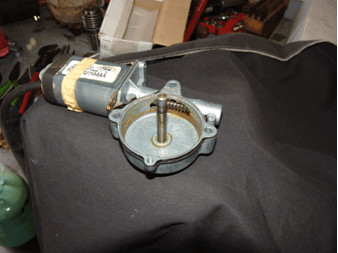
It was and still is very common for the torque pins inside Ford and some Chrysler power window motors to fail. The following instructions are for repairing the motor once it is out of the door. A Ford motor is being shown. Chysler motors are similar but the gears are installed backwards.

Remove the single screw that holds the dust cover in place.

Remove the dust cover.

Pull the metal gear out of the motor assembly. Sometimes there is a very small “C” clip that has to be removed first.

Remove the plastic gear and clean debris from gear. Inspect the outer gear teeth for damage. If no damage is found, place the plastic gear on a flat surface and with a punch and hammer beat the plastic back down where the metal gear pushed it up.


Next clean the debris from the motor housing. Use a pick or similar device to get all of the small pieces out. DO NOT USE AIR OR SOLVENT AS THEY CAN DAMAGE THE MOTOR. To fully clean all debris from the motor you may need to plug it back into the door and run the motor in both directions to expose all fragments. You can also use a battery if you wish.

After all cleaning and prep work is done you can assemble the pieces back together.

Place all of the pieces together as shown below. You can place two of the torque pins and the two gears together very loosely and then position the third torque pin into position at an angle as shown.

When all of the pieces are in place squeeze firmly until fully seated.

This particular type of motor out of a 1993 Town Car does not use much grease and I do not recommend adding any as very little is lost if you clean it properly. If you add too much grease to this type of motor it will only work about a dozen times before it fails and has to be removed to clean the grease off of the brushes and commutator. Yes, I know this from experience. If your motor is round, the wires are attached at the far end of the motor from the transmission assembly and was originally packed with grease then you may grease to your hearts content. Otherwise do not.

Place the dust cover into position.

Install retaining screw.

Test the motor functions before completely installing and if all is well install in the door.

1989 Dodge Dakota Blower Inop

1989 Dodge Dakota with a complaint of no blower operation. I have had lots of experience with these and went straight to the problem. Luckily this year model has the blower resistor in a convenient location. Sometimes they are inside the dash or under the washer reservoir at the cowl area on various Chrysler, Dodge and Plymouth products.

After unplugging the harness connector and removing the two screws, I could remove and examine the resistor coils for damage.

The heat and subsequent rust damage are clearly visible in the pictures.

Installed the new resistor and I did reconnected the harness even though the picture shows it still disconnected. Checked blower operation and all speeds now work.

As a side note it does not hurt to check to make sure rain water will drain out of the area and make sure there are no leaves or other debris restricting air flow through the evaporator or heater core.

If the connector is burnt and you need to replace it, click here for product information.

If you have any questions, please email me at info@the-electric-connection.com.

1989 Cadillac Deville Park / Tail Lights Stay On

This 1989 Cadillac Deville came in with the park / tail lights staying on. This is a fairly common problem on 1980’s and early 1990’s Cadillacs with Twilight Sentinel headlight systems.

The Twilight sentinel module is located on the rear of the dash panel behind the headlight switch. The following picture is taken from the floor board looking up. You can see the parking brake assembly with vacuum pull off to the right of the picture and the module is the white box at the bottom left of the picture.

There are two 7mm headed screws that attach the module to the dash and the are easy to access with an extension.

After removing the module from the dash the next step is to remove the harness connector and check light operation.

The lights now worked properly with the manual switch.

I opened the module cover.

Removed the circuit board and inspected for damage. The outer bar or armature showed signs of overheating and the plastic had melted, cooled and subsequently stuck the contacts in the on position.

The customer did not want to replace the module so the wiring harness was taped up and secured out of harms way. The headlights and tail lights will work with the manual switch with no adverse effects.

1997 Nissan Maxima Code P0325 Knock Sensor

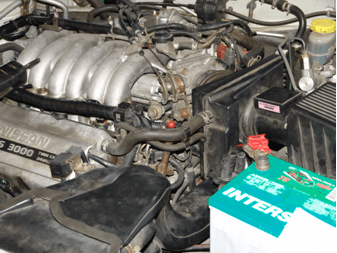
Code P0325 stored in 1997 Nissan Maxima. Because the knock sensor is normally at fault I usually test it first. The knock sensor is located under the intake and is accessible on the driver’s
side of the car.

Locate the knock sensor subharness connector. It is near the dipstick tube, red knob in center of above picture.

Disconnect the sensor and check resistance from terminal #1 (white wire) to engine ground. resistance should be between 500K -620K ohms. If the resistance is not within the specifications the sensor and subharness must be removed to do further testing. If it is within specifications recheck while wiggling the subharness wires. If still no problem is found the wire between the computer and the knock sensor must be checked for opens or grounds.

In this and in most cases it was not within specifications. Now comes the tricky part, the labor guides give 2.9 hours to change the sensor and it requires removal of the intake. I have a short cut if you have some tools and patience it can be done in about half an hour or so. I always try to see if I can break the attaching bolt loose with a swivel socket and extension. If it does then great ,simply remove the bolt and use the subharness to pull the knock sensor up and out. DO NOT BEND THE HARNESS . You need to keep it in it’s original shape to reinstall the sensor without any difficulty.

If the bolt will not break loose easily, what I do is with the help of a telescoping magnet, I lower a long 12 point boxed end wrench into position on the knock sensor retaining bolt. Then I use a long skinny screw driver to hold the wrench in place while the magnet is removed.

Then while keeping the wrench in place with the long skinny screwdriver I put a heavy pry bar into position to use as a lever to move the wrench.

After the bolt is broken loos it is easy to remove with the swivel socket and extension used earlier.

With the sensor and subharness removed it is now easy to check the sensor. This one like many has an external split and tested faulty.

To install the new knock sensor, attach the subharness and drop the attaching bolt into the sensor. Using a long skinny screwdriver or a mechanics finger (actual name of tool) as a support and guide lower the sensor and bolt into position. Once you feel the the bolt drop into the threaded hole, use the harness to maintain this position. Next place your swivel socket and extension in place without moving the bolt from it’s centered position. Gently turn the bolt making sure not to cross thread it. It may take a few attempts. Be patient and very gentle as it will be a 3 hour mistake. Once the bolt is tightened with the swivel socket, I usually drop the wrench back in place and put a final tightening on it with the pry bar as outlined in the removal procedure. DO NOT OVER TIGHTEN.

1999 Buick Century Windows Inop, Circuit Breaker Gets Hot and Sparks From Door Hinge

This 1999 Buick Century came in with the customer complaint of Sparking in the driver’s door hinge and now the power windows are inop. Checked the circuit breaker in the passenger side fuse box and it was smoking hot. I decided to disconnect the battery and wait for things to cool down.

Common sense would dictate that the short was most likely in the driver’s door as that was were the customer had seen sparks flying.

Using a small screw driver I slipped it under the front edge of the power window switch bezel plate and pushed to the rear edge of the door to release the retaining clip.

I then removed the two screws in the pull handle recess. A plastic cover first had to be lifted off.

One screw had to be removed from the interior handle recess and then the panel could be pulled off. this panel has several spring clips holding it in place.

After the trim plate with the power door lock was fully removed I then pulled and released the entire door panel. Several specialized tools are made for this but most of the time good strong fingers are all that are needed. A wide flat tool made for prying helps. Be sure to put tape or other protective material on the painted surfaces before doing any prying or you will damage the paint.

Well, the short was pretty easy to spot. The yellow power window wire had been rubbing on the metal door panel retaining bracket.

It had also cut into a major ground wire and when the two wires touched the bracket at the same time a very strong short was created. The owner was kind of lucky that the door panel did not catch on fire.

I cut out the damaged wires and spliced in new wire. Wrapped with tape and reassembled the door panel and switches

1998 Ford Expedition, No Air From Vents, Air Only Flows From Defrost

After looking at diagrams I found that this Expedition uses vacuum controls to change door positions. I started looking for vacuum line problems under the hood and found the problem behind the battery.

You can see the damaged section of the small plastic vacuum line, just slightly lower than center of the following picture. It is bent at almost 90 degrees.

vacuum hose repair 1

After removing the battery to gain access, I cut out the damaged part of the hard plastic vacuum line and replaced it with a piece of rubber line that I placed over the original line. Make sure it is a snug fit.

I used 1/8 inch fuel line in this particular vehicle and it worked well but i prefer to use 7/64 thick wall vacuum line. I was out of my favorite.

Installed the battery and tested the system. Now works as designed. Leaking batteries cause a lot of problem. The customer had recently replaced the battery but had waited too long.

2000 Chevrolet C3500 Intermitent Battery Drain

2000 Chevrolet C3500 pickup with intermittent battery drain. Installed amp meter in between battery negative post and negative battery cable. A test light can be substituted if needed but not really recommended. Let vehicle sit for about 45 minutes to ensure all modules had gone to sleep and a .85 amp drain remained.

Removed all interior fuses until drain went away. drain was on the courtesy light fuse. Unplugged door jamb switches and drain remained. Unplugged headlight switch and the drain remained. Unplugged dome light assemblies with reading lights, drain remained. Closed doors and consulted wiring diagram. Came back to vehicle to removed the delay interior light module but drain was gone. Ain’t life grand!!!
Well the only thing I could think of that I had done different before leaving the vehicle was to close the door. I adjusted the meter so that I could see it from the driver’s door and slowly opened the door. At about 2/3 open the drain came back. Closed it back to about 1/2 and drain went away. Drain is inside the driver’s door. Removed the door panel to start inspecting.

After removing the door panel, vapor barrier and speaker I had access to where I believed the short may be. I had fixed a similar problem a year or two earlier. There is a bracket that attaches the front window channel to the door and the harness is very close to it. Yep, there it is.

After gaining some room to work I found that the white wire that controls the ground side of the interior lights was indeed the culprit. According to the wiring diagram this wire in the door will activate the system even with all of the switches removed.

Not much damage so I wrapped the wire with tape and then retaped the harness.

For added protection I then place a piece of split loom around the harness.

I then positioned the wiring harness back in place but directed it away from the bracket.

Reinstalled all door components and reconnected all of the switches. retested for a drain just to be sure and all is well.