2002 Buick Lesabre, P0205 & P0443

This 2002 Buick Lesabre came in with the complaint that it was running real bad and service engine soon light was on. It ran so bad that the customer had it towed in rather than drive it in. A quick check of the codes and a P0205 and a P0443 were stored. The P0205 was for a fault with the number 5 injector so I figured that would be a good place to start my inspection. I removed the engine trim panel and the problem was quite evident. Rats!!!!

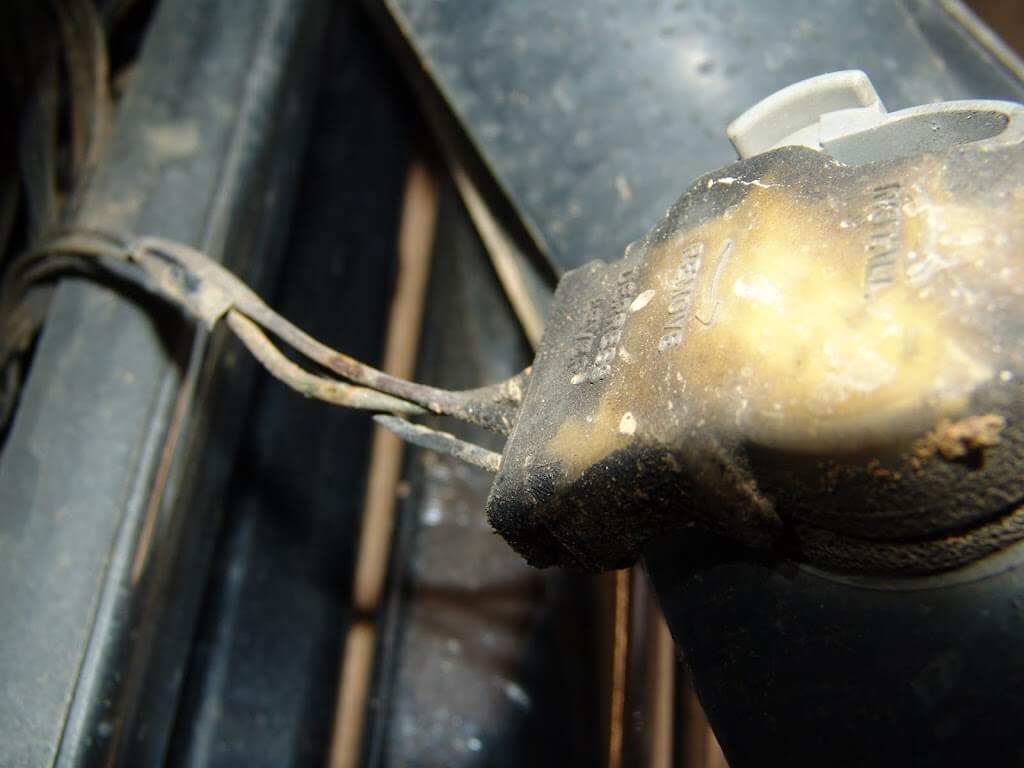
If you click on the picture below and enlarge it you will see that the injector wiring is badly chewed and you might even see the chewed wires going to the EVAP canister purge solenoid (probable cause of the code P0443)

The rat was trying to build a nest on the back side of the engine.

After vacuuming up the debris, I installed a new harness connector for the #5 injector and repaired the wiring for the EVAP canister purge solenoid.

Taped the harness up and plugged in the harness connectors. After clearing the codes and a quick test drive this one was done.

2002 Oldsmobile Bravada, Driver’s Side Headlight Not Working

This 2002 Oldsmobile Bravada came in with several complaints among which was one that the driver’s side low beam headlight was not working. I was so sure that the connector was burnt out, that I had a new connector and bulb ready to go in. I also was concentrating on the wiring repair and did not take any pictures of actually removing the light assembly. Not very hard though. Pull the locking bars up slide the light out far enough to disconnect the wiring and it was out. Now that the light is out and sitting on my tool box it is time to get to wiring.

Well maybe not.

The connector was fine and all it needed was s simple bulb replacement. Kind of boring but oh well. If it had been burnt out like so many are on the Bravada, Envoy and Trailblazers are then you can see how that is done in the post at this link.

DSC02968

1997 Chevrolet C1500 Pickup, Park Light Fuse Blows

This 1997 Chevrolet C1500 pickup came in with the complaint that the park or tail light fuse would blow. i did a quick inspection of the trailer wiring at the rear of the vehicle and all was well back there. I turned my attention to the front park lights. Four phillips headed screws and it was out. This is what I found. You may need to click on the image below to enlarge it to see the shorted wire behind the driver’s side front park/turn signal assembly.

The rust spot in the center of the picture below is where the wire was rubbing and shorting out.

A little bit of tape and repositioning and this one was done.

This is a very common area for shorts in this era of Chevrolet and GMC full sized trucks including the Pickup, Tahoe, Yukon and Suburban models. The shorts can involve the park lights or turn signals. This particularly true if there has ever been front end damage to the vehicle.

2003 Mazda Tribute, Door Ajar Light Stays On

This 2003 Mazda Tribute came in with the interior lights on and the door ajar light in the instrument cluster on. I started by checking the data the door positions. All door positions showed as being closed or “no” according to the data stream except for the hood. It showed being open or “yes”. I checked very carefully and found that there was not a hood ajar switch under the hood at all. Seems like false data. It happens.

The only thing that I could not get a data line for was the rear hatch glass. Maybe an engineer decided to call this the hood? Time to take something apart.

I started by removing the screws at the lower edge of the rear hatch assembly. Phillips headed screws.

Four screws altogether as seem below.

The rest of the panel is held in by spring clips that have to be popped loose. I did have to raise the glass up though in order to “unhook” the upper edge of the panel.

Below you can see the latch assembly for the rear glass.

With the rear glass up, I loosened the attaching bolts and slid the latch towards the glass. It took a couple of tries at adjusting the latch before I got it right. I wanted to make sure that glass would also seal when closed.

After checking the operation of the lights all was well. A couple of things of note were that the hood ajar data line never changed and that in testing I opened the rear glass and with a screws driver I closed the latching mechanism to simulate a fully closed glass condition and this did turn the lights off. It does take a minute or two for the lights to time out after closing the doors. Normal.

2002 Oldsmobile Bravada, Tail Lights Inop

This 2002 Oldsmobile Bravada came in with the complaint the that driver’s side tail light was not working. A little disassembly and the problem was quite evident. Water intrusion had damaged the harness connector and the socket circuit board assembly. In the following picture you can see that the terminal on then far right side is missing.

If you click on the picture below you can see the rust film in the individual terminals and the harness connector.

I spliced in a new harness connector assembly. I staggered the joints so that the repair would be neat and tidy.

Wrapped it up with electrical tape. To purchase the connector please click here.

Installed a new light assembly and this one was done. The old assembly was cracked and the cause of the water intrusion. To purchase new light assemblies please click here.

The following picture is of the original tail light assembly. As you should be able to see the only difference between the two is the yellow or amber area for the turn signal.

2006 GMC Sierra, Changing the Driver’s Outside Mirror

This 2006 GMC Sierra came in with multiple problems related to being struck by lightning. It was only during the process of repairing other systems that I noticed that the glass in the driver’s side mirror was etched with actual lightning bolts. I personally think it is kind of cool to have a physical recording of a lightning strike.

A close up of the left lightning bolt.

Anyway back to then actual matter of replacing the mirror assembly. What ever you do, DO NOT try to lift the switch assembly off of the door panel. It is screwed on from the inside of the door panel.

Start by removing the interior handle trim plate.

There is a plastic cap covering a torx screw at the rear edge of the door panel.

With the cover removed the screw can now be taken out.

There is a 7 mm headed screw below the pull handle. There are several 7 mm headed screws involved in removing the door panel and they are different lengths and thread types so please keep them separated.

The door lock panel has to be carefully pried out to reveal the screw in the picture below.

There is another screw on the underside of the door panel as well.

A push pin retainer at the front of the panel. Be careful not to scuff the door panel.

Unsnap the interior trim cover for the mirror. Grab it at the top and pull it away from the door to release the spring clips.

Now lift the door panel straight up and then away from the door. Don’t pull too far though because there are some wires that have to be disconnected.

The largest connector is probably the most difficult if you do not know how the locking mechanism works. While attached to the power window switch (actually it is a Diver’s Door Module or DDM) the gray lever would be in front of my finger tip. I am pointing to the lock that has to be depressed before the gray lever can be rotated and the connector released from the DDM.

Just a side view of the connector to left you see the rotating point of the gray lever. The rest of the connectors have locking tabs that have to be depressed using your fingers or a small screwdriver.

Now that the door panel is removed the plastic can be carefully pulled back and the harness retainers can be pull loose from the door.

Pull the foam insulator out of the hole.

Remove the three 10 mm nuts from the mirror studs.

Be careful to support the mirror while doing this so that it will not slip and damage paint.

Reverse the process to assemble. Luckily this was a standard camper type mirror assembly and it does not have any programming involved. Some of the retractable types do have programming involved when the DDM is replaced.

2001 Pontiac Grand Am, Fixing The Turn Signal Switch

On the previous post I had already removed the turn signal switch shown below. To view that post click here.

I placed the switch in a clean secure location because I did not know what might pop out of it. I have never had one of these apart before.

I flipped it over and found multiple torx screws.

I started removing them with my trusty ratcheting driver.

I found that I had to use a regular torx driver for one screw due to clearance against the housing.

With all of the screws removed I separated the halves and luckily nothing popped out. The first thing I noticed was the dark colored grease that not only was on the contact surfaces but in between them. The grease in the area to the left was clear.

Same thing with the contacts on the other half of the switch. Clear grease versus dark grease.

I could see no reason for there to have been two different types of grease used so I removed the old grease with a rag and then started cleaning the contact surfaces with an eraser. By the way an eraser is the absolute best thing to clean tarnished contacts with.

Now the contacts are nice and clean. The depression in the center contact looked like it was that way from the factory and not caused by wear.

Using a pocket screw driver, I removed the dark grease from the slots between the contacts.

I lightly coated the contacts with dielectric grease.

I made sure the spring in the center of the picture below was securely installed in it’s hole and put the two halves back together again.

I installed the switch and the problem was gone. Now for what had happened. The turn signals are the most used part of that switch and transfer of copper and copper oxides had built up in the grease and as a result the grease would conduct a slight bit of current. This current would keep the relay working even though technically it was not commanded to.

The above picture shows the horn contact that has to be pushed and held in so that the switch can be installed on the steering column.

2001 Pontiac Grand Am, Turn Signals Click After Switch Is Off

This 2001 Pontiac Grand Am came in with the complaint that there was a ticking noise that continued after the turn signals switched off. I knew that the hazard switch on this car had already been replaced so I was pretty sure it was not the problem. I decided to look at the turn signal switch and wiring.

To gain access to the switch and wiring I had to remove the screws that hole the steering column covers together. I could then flip the top cover up on the forward edge and lifted it off of the rear hinges.

Using a screw driver for leverage I tried to remove the tilt lever handle. It seemed to be stuck so after looking the situation over I decided that the lower cover did not have to come off anyways so there was no need to remove the handle.

With the top cover removed I could then turn turn my attention to removing the switch. One screw in the top of the switch had to be removed. the switch could be rocked and lifted off the column.

The switch could then be rocked and lifted off of the steering column.

I turned the signals on and off to duplicate the condition. Then I disconnected the four wire connector at the top edge of the switch that holds the turn signal control wires and the ticking stopped.


Time for a new switch. I had to wait on a new switch so I decided to see what failed in the old one. Very interesting and cheap repair. I will do a post on it very soon. The next post is done. Please click here to view.

1999 Chevrolet Venture Van, Door Locks Do Not Work

This 1999 Chevrolet Venture van came in with the complaint that the power door locks only work in one direction. This repair applies to all GM mini vans through the 1990’s and early 2000’s. Venture, Montana, Lumina and Silhouette. A quick test at the switch revealed that there was a wiring problem and knowing these vans, it is in the same disgusting place it always is. Under the passenger side carpet, where water has accumulated and rotted out the splice connections. Of course I’m putting on gloves for this one. i pulled the rocker trim panel up and lifted the edge of the carpet and mat.  A gentle squeeze and water will pour out. If you own or ever go to buy one of these vans, do yourself a favor and find out if it has a water problem before it is too late.

If you click on the picture below you will see the broken end of the white wire and the black tape wrapped around the other two white wires to the upper right corner.

A few clips, a new piece of wire and some heat shrink and this one is done. There are several splice joints in this area that affect multiple systems including power door locks, power windows and interior lights.

1995 Chevrolet Monte Carlo, Changing The Turn Signal Switch

1995 Chevrolet Monte Carlo changing the turn signal switch due to inop stoplights. To view diagnostics for this repair please click here. The first step is to disable and remove the air bag assembly according to manufacturers guidelines. If you do not have a manual you can purchase from either Mitchell or AllData. There are ad links to both on this page. With the airbag out and safely stored the nut holding the steering wheel in place needs to be removed. The front wheels need to be pointing straight ahead before proceeding.

Next a steering wheel puller must be used to press the wheel off of the shaft.

Once the steering wheel is loose mark the shaft and the wheel to make sure they go back together in the same position as removed. There should a factory mark present but I prefer to add my own. I guess it is a habit as they were not marked when I first started working on steering columns.

Now that the steering wheel is out of the way you can clearly see the airbag clock spring. There is a snap ring that has to be removed to take the clock spring out.

After lifting the clock spring assembly off of the shaft, pull the wiring slightly up and let the assembly hang out of the way. One important thing to note is the internal portion of the clock spring should not be allowed to turn or it will have to be reset to prevent damage.

There is a thin wafer washer that needs to be removed.

The next step requires another special tool to compress the locking plate and the spring that is underneath it. With the plate depressed the retaining ring has to be removed. This is a tedious job that requires two very small screwdrivers and a lot of patience.

With the snap ring removed the locking plate can be pulled off. It is indexed and can only go one one way.

After removing the turn signal canceling cam, inspect it carefully for crack where the horn wire with spring attaches to it. Replace it now if any damage is present. If not it will likely break when you reassemble the air bag into position and connect the wiring.

Finally you can at least see the turn signal switch. Remove the two phillips headed screws that hold the lever to the switch. The two screws are very different and putting the wrong screw in either position will cause problems.

Now that those two screws are put in a safe place you can now move onto the three screws that hold the turn signal switch in the steering column.

Now move down to the base of the column and remove the gang connector with the 7 mm headed screw in the middle of it. Separate the connectors and lift the turn signal portion with a small screwdriver and slide it out of the main connector. To reassemble, the new connector and wires have to be guided down through the column. Because of this I always try to remove the old switch the same way so that I know how the wires go through. But in some cases I will cut the old wires and remove the switch more easily.

After reassembly I checked the brake lights and turn signals and all is well.